Direct Trade: What It Is & What It Isn’t | #PSC 227
OVERVIEW: Episode 227 of #PodSaveChocolate takes a look at how Direct Trade is defined in cocoa and in coffee – on a journey to understanding the key concepts that define what “Direct” means (and doesn’t).
Click a link below to view the archived episode.

Watch and comment LIVE or view the archived episode!
Subscribe (free!) to the @PodSaveChocolate YouTube channel, like this video, comment, and share this episode to help grow the #PSC community.

Watch and comment LIVE or view the archived episode on LinkedIn.
Join my network on LinkedIn to receive notifications and to refer business to each other.

Watch and comment LIVE or view the archived episode on TheChocolateLife page on Facebook (for 30 days, then watch the archive on YouTube).
Follow TheChocolateLife on Facebook to receive notifications and catch up on other content.
Episode 227
“Direct trade,” like “bean-to-bar,” and “craft/artisan” is one of those terms that has no one settled definition. But, like most things in chocolate and cocoa, precise definitions matter.
In this episode of PodSaveChocolate we’ll take a stab at arriving at a definition for Direct Trade that covers all of the essential bases without including concepts that confuse the discussion, making it more difficult to gain broad acceptance.
How Others Define Direct Trade
The IESC/USDA Global Cocoa Market Study opined – What the specialty sector calls Direct Trade usually involves an importer acting as intermediary and contact point between producer and maker. The study notes that the number of specialty importers serving small makers is low, which makes that “market access point very concentrated.”
Intelligentsia Coffee’s published criteria, which the coffee sector still treats as the reference implementation, and it remains the most specific. Five criteria covering quality, farm practice, price, financial disclosure to farmers, and visit frequency.
Counter Culture built the thing everyone says is missing, then they retired it. Their reasoning at the time was that the verification existed because customers find it hard to trust what a company says about itself, and notably that the scheme deliberately put no certification cost on the farmer and aimed scrutiny at the buyer instead. The replacement is guidelines rather than guaranteed standards with quantified minimum requirements, monitored internally and self-reported. Their own argument for the change was that monitoring should be more about data than verification. [A March 2026 CoffeeGeek piece describes the current published standard as a minimum 25 percent above Fair Trade and visits at least once annually, which is looser on frequency than the 2008 once-per-harvest-season language. Either the standard was quietly relaxed or the secondary sources are drifting. A point for further fact-checking.]
Taza, which built the chocolate industry’s first third-party certified Direct Trade cacao sourcing program, sets the bar at a different place. Their standard is to meet producers in person or via video conference at least once every year. (That video conference clause is a genuine divergence from my definition, but it may be a COVID-era accommodation.)
Uncommon Cacao takes title. Under my definition (below), a maker buying from them is not doing Direct Trade. Co-founder Emily Stone avoids the term precisely because it isn’t clearly defined and describes too wide a variety of sourcing practices.
Cocoa Supply also takes title (and thus does not qualify as Direct Trade in my view). There is an extensive description of their approach on this page that is worth reading.
Cocoa and Chocolate
| Company | Role | Ownership between farmer and buyer | Visit requirement | Price rule | Outside verification |
|---|---|---|---|---|---|
| Taza Chocolate | Maker (US) | Buys from co-ops and farmer associations, imports directly | At least once a year, in person or by video | $500 over market, 15 to 20 percent premium, floor of $2,800 per MT | Annual, by a USDA-accredited organic certifier |
| Askinosie Chocolate | Maker (US) | Buys from grower groups, acts as own importer, pays farmers in person | Founder visits each farm every year | No fixed rule. Reported averages of 35 percent over world market and 25 percent over Fair Trade across eleven years, plus profit share | None found. Self-published reports |
| Beyond Good | Maker at origin (US/Madagascar) | Buys at origin, owns the factory there | Not published | 3 to 5 times the Fair Trade standard | Packaging says "Certified Direct Trade." No certifier named |
| Dandelion Chocolate | Maker (US/Japan) | Estates, co-ops, and importers | Not published | None. Publishes prices per metric ton | None. Claims not stated as commitments |
| Goodnow Farms | Maker (US, very small) | Direct from farmers | Not published | Two to four times typical commodity price, sometimes prepaid | None found |
| Uncommon Cacao | Trader/importer (US) | Takes title. It is the intermediary | Not published | Higher price for higher quality | Declines the term. Publishes all prices and margins |
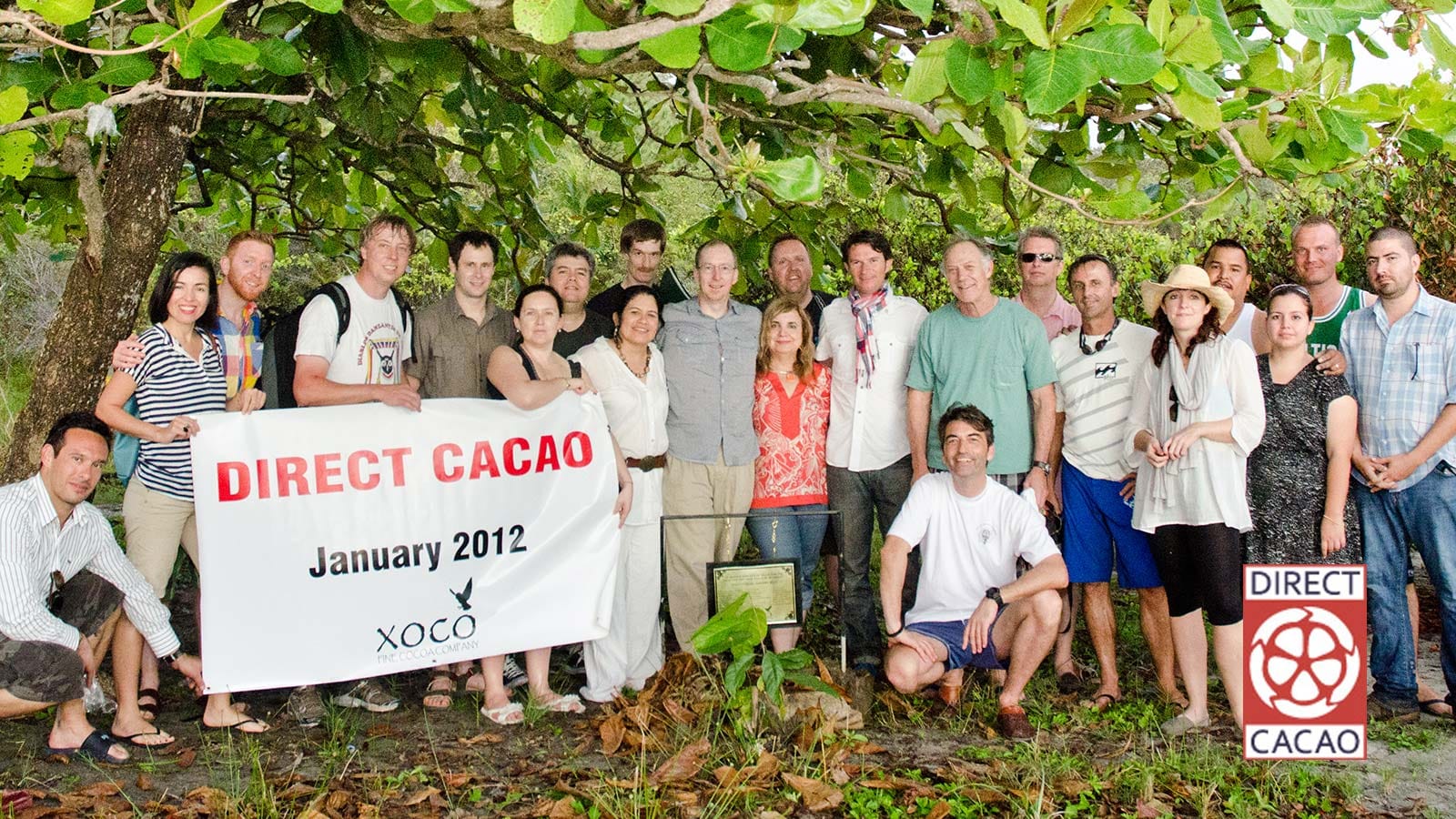
A group led by Frank Homann, Gary Guittard, Martin Christy, Maricel Presilla, Santiago Peralta, Mikkel Friis-Holm, and others tried to create a direct trade association for cocoa called Direct Cacao, which appears to be moribund. There are only a few snapshots on the Archive.org Wayback machine making it difficult to reconstruct what the group was promoting.
Coffee
| Company | Role | Ownership between farmer and buyer | Visit requirement | Price rule | Outside verification |
|---|---|---|---|---|---|
| Intelligentsia | Roaster (US) | Buys from grower or local co-op; still uses importers | At least once per harvest season, often three times a year | At least 25 percent above the Fair Trade price | None. Unregistered trademark from 2002 |
| Counter Culture | Roaster (US) | Not defined structurally | Not published | Not published | Third-party verifiable standards from 2008, since replaced by Purchasing Principles that are guidelines rather than standards with quantified minimums |
| Stumptown | Roaster (US) | Not defined structurally | Not published | Quality-based, disclosed | None. Reserves the term for coffees sourced at least three consecutive years |
| Onyx Coffee Lab | Roaster (US) | Declared per lot. Importer purchases labeled as such, with FOB and farm gate marked unknown or proprietary | Not published | None. Publishes FOB price, volume, premiums, and the commodity and Fair Trade prices at time of purchase | None. Self-published, per lot |
| Tim Wendelboe | Roaster (Norway) | Declared per origin. Direct from farmers in Central and South America, via an importer in Ethiopia, from co-op wet mills in Kenya | Regular visits, not quantified | None. Annual transparency reports | None. Self-published |
| Cafe Imports | Importer (US) | Is the intermediary. Argues the category has to include them | Not applicable | Encourages higher prices, no rule | None. Offers to help roasters hire a reviewer for a proprietary company seal |
| Sustainable Harvest | Importer (US) | Is the intermediary. Uses "Relationship Coffee" instead | Not applicable | Negotiated between roaster and grower | None. Connects buyers to growers to negotiate price directly |
Coffee Roasters Who Also Make Chocolate
| Onyx Coffee Lab | Terroir by Onyx | Encore Coffee | Encore Chocolate | |
|---|---|---|---|---|
| Term used | Transparent Trade, direct trade declared per lot | "Ethically sourced cacao" | Ethically sourced | "Ethically sourced cacao" |
| Structural claim | Yes. Importer purchases labeled, with farm gate marked unknown or proprietary | None | None found | None. Buys through a specialty importer |
| Price disclosed | FOB, volume, premiums, comparison prices per lot | Green Cost field present, unpopulated | No | No |
| Origin detail | Farm, score, process | Farm, fermentation, drying, aging | Origin country | Named fermentary or estate |
| Verification | Self-published. Certified B Corp | Same | None found | None found |
How I Define Direct Trade
Direct Trade is a claim about the structure of a supply chain. Direct Trade is not a claim about prices paid, nor is it a claim about farming practices, labor, gender equity, deforestation, or concepts that better fit within definitions of “sustainable” or “ethical” sourcing. Keeping the definition streamlined is what makes it useful and usable. That is not a loophole. It is the point.
The two concepts central to how I think about Direct Trade are:
- There is no change of ownership between the farmer (or co-op) and the maker.
- A regular, ongoing, in-person relationship. An authorized representative of a maker must make at least one documented, in-person visit every year, ideally during the peak harvest season, sustained over 3+ years.
- Documentation and verification are not parts of the definition. Documentation and verification are how you demonstrate you meet the definition, which is a different job.
Why I Focus on Ownership, Custodianship, and Payment
As demonstrated, there is no single definition of Direct Trade and no common set of standards, which is why ownership and payment are the only criteria that produce a yes or no answer rather than a story.
Sources
Chocolate and Cocoa
- Taza Chocolate transparency and Direct Trade program: https://www.tazachocolate.com/pages/direct-trade
- Askinosie Chocolate sourcing: https://askinosie.com
- Beyond Good: https://beyondgood.com
- Dandelion Chocolate sourcing reports: https://www.dandelionchocolate.com
- Goodnow Farms: https://goodnowfarms.com
- Uncommon Cacao transparency reports: https://uncommoncacao.com
Coffee
- Intelligentsia Direct Trade: https://www.intelligentsia.com/pages/direct-trade
- Counter Culture 2009 Direct Trade Transparency Report: https://counterculturecoffee.com/wp-content/uploads/2016/08/CCC_Transparency-Report_2009.pdf
- Cafe Imports, "A Series about Certifications, part 5 - Direct Trade": https://www.cafeimports.com/north-america/blog/2021/01/28/a-series-about-certifications-part-5-direct-trade/
- Onyx Coffee Lab, The Culture (per-lot transparency ratings): https://onyxcoffeelab.com/products/the-culture
- Tim Wendelboe transparency reports: https://timwendelboe.no/blogs/transparency
- Sustainable Harvest Relationship Coffee Model: https://www.sustainableharvest.com/our-model
Crossover makers
- Terroir by Onyx, 77% Ecuador: https://onyxcoffeelab.com/products/77-ecuador-dark
- Terroir by Onyx, India Chai Milk: https://onyxcoffeelab.com/products/india-chai-milk-chocolate
- Terroir collection: https://onyxcoffeelab.com/collections/terroir
- Encore Coffee and Chocolate: https://www.encorecoffeeco.com/collections/chocolate
- Martin City Telegraph on Encore sourcing: https://martincitytelegraph.com/encore-coffee-companys-chocolate-deserves-applause-too/
Future Episodes
Debunking Junk Internet Health Claims – this is a topic that came up during PSC Ep 226 featuring Keith Ayoob.
Celebrating(?) the 25th anniversary of the signing (on Sept 19, 2001) of the Harkin-Engel Protocol with confirmed special guests Terry Collingsworth and Miki Mistrati.
Episode Hashtags
#DirectTrade
#cocoa #cacao #cacau
#chocolate #chocolat
#PodSaveChoc #PSC
#LaVidaCocoa #TheChocolateLife
#PodSaveChocolate and #TheChocolateLifeLIVE Archives
To read an archived post and find the links to watch archived episodes, click on one of the bookmark cards below.
 Clay Gordon
Episodes 201-300 (links to older PSC archives are in the top nav).
Clay Gordon