Change.org petition: Keep “Chocolate” Tied to the Cacao Tree
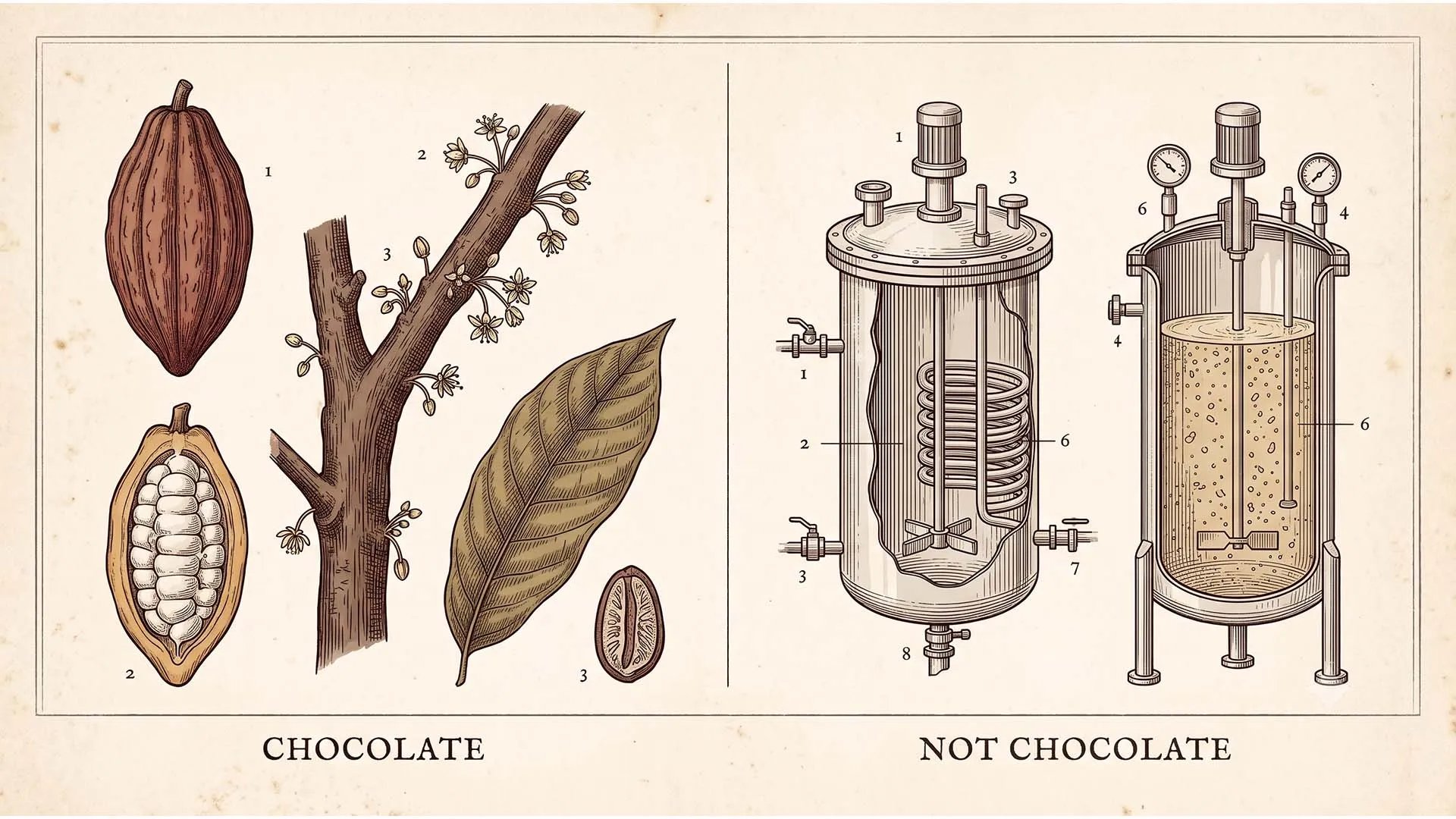
I started a petition on Change.org that urges the FDA to prohibit products made from “engineered cocoa substitutes” (my preferred term over lab-grown cocoa) from being labeled as chocolate. If you agree, sign the petition and encourage others to sign it, too!
Keep “Chocolate” Tied to the Cacao Tree
In support of a citizen petition to the U.S. Food and Drug Administration (“FDA”), urging them to not amend 21 CFR Part 163 to permit products made with engineered cocoa substitutes (materials produced by microbial fermentation, plant cell culture, enzymatic synthesis, or any comparable technology now known or later developed), to be labeled “chocolate.”
Instead, establish “artificial chocolate” or “engineered chocolate” as the required common or usual name for those products, and permit “natural chocolate” as an optional designation for products made from the seeds of the Theobroma cacao tree.
 Part 10
This would be the next step, assuming a sufficient number of signatures was collected at change.org.
The Rationale
The current standards of identity are tied to a plant, not to a flavor
Every standard in 21 CFR Part 163 rests on a single foundation: Section 163.110 defines cacao nibs as the material obtained from cured, cleaned, and roasted cacao beans, the seeds of Theobroma cacao. Chocolate liquor (§163.111) is made from those nibs. Cocoa (§163.113), breakfast cocoa (§163.112), sweet chocolate (§163.123), milk chocolate (§163.130), and white chocolate (§163.124) each incorporate that starting material by reference.
The identity of chocolate under existing federal law is therefore a raw-material identity. It is not a specification for taste, texture, or melting behavior.
Admitting non-cacao inputs would not refine the definition. It would sever the definition from its referent while leaving the name in place.
The FDA has already answered this question, inside Part 163
Congress directed the FDA to set standards of identity to promote honesty and fair dealing in the interest of consumers (21 U.S.C. 341). Applied to cacao products, the FDA has consistently required a distinct name whenever composition departs from the standard.
Replacing cocoa butter with vegetable fat, a far smaller change than replacing cacao itself, does not yield “chocolate." It yields “sweet cocoa and vegetable fat coating” (§163.150), “sweet chocolate and vegetable fat coating” (§163.153), or “milk chocolate and vegetable fat coating” (§163.155). Products under §163.153 and 163.155 may use the word chocolate only when it is followed by the specific name of the vegetable oil used.
Likewise, when the industry sought recognition for a product lacking nonfat cacao solids, the FDA did not stretch “chocolate” to cover it. It wrote a separate standard with a distinct name: white chocolate (§163.124).
That is the guiding precedent here.
The requested nomenclature follows established practice
“Natural” is not a marketing adjective in this commodity. It is a trade term with a regulatory origin.
Part 163 requires that alkali-processed cacao products declare “Processed with alkali,” and industry and consumer usage of natural cocoa for unalkalized cocoa developed directly from that disclosure requirement. Extending the same word to distinguish tree-grown material builds on existing understanding rather than inventing a category.
Process-based qualifiers are ordinary in federal food labeling. Juice must disclose reconstitution. Cell-cultured meat and poultry are subject to a 2019 FDA–USDA agreement and to FSIS labeling requirements, precisely because production method is material to a purchasing decision.
Note the gap that makes affirmative rule-making necessary.
The imitation provision at 21 CFR 101.3(e) is triggered only when a substitute food is nutritionally inferior. An engineered cocoa substitute formulated to match or exceed cocoa’s nutrient profile would escape that provision entirely while displacing the product consumers believe they are buying. A dedicated “artificial chocolate” designation closes that gap.
Analytical enforceability collapses without a botanical anchor
Part 163 is enforceable today because cacao-derived materials carry measurable, characteristic signatures: the POP/POS/SOS triglyceride distribution of cocoa butter, its fatty acid profile, theobromine-to-caffeine ratios, shell content limits, and ash and alkalinity specifications. These are the tools regulatory and industry laboratories use to detect substitution and adulteration.
If “chocolate” may lawfully contain material engineered to hit those same specifications, the tests lose their referent. The compositional limits in Part 163 become unenforceable as a practical matter, and the burden of proving authenticity shifts onto manufacturers who have done nothing but comply.
Verification of every origin claim and certification designation rests on that same physical chain of custody.
The commercial effect is transfer, not innovation
Millions of smallholder households in more than 60 countries grow Theobroma cacao trees. The traceability infrastructure now being built to satisfy deforestation and forced-labor due diligence obligations presumes an agricultural supply chain that can be audited back to a farm.
Allowing engineered substitutes to carry the unqualified name transfers two centuries of accumulated consumer trust to products that carry none of the corresponding compliance burden.
That is not support for innovation. It is a transfer of goodwill away from the parties who built it.
What the citizen petition will not ask
We are not asking the FDA to prohibit engineered cocoa substitutes, to restrict the underlying technology, to require warning statements, or to make any finding about safety or nutrition. (Safety review belongs in the GRAS and food additive pathways, where it is already proceeding.)
We ask that these products be named accurately.
Distinct nomenclature has not suppressed plant-based dairy or cultivated protein; both categories have grown under qualified names. Clear naming serves these manufacturers as well, by letting them market the specific attributes of their process rather than borrowing an identity that describes something else.
What the citizen petition will ask
- Decline to amend Part 163 in any manner to admit inputs not directly derived from the tree-grown seeds of Theobroma cacao into the standardized foods defined therein..
- Establish “artificial chocolate” or “engineered chocolate” as the required common or usual name for any product in which cocoa solids or cocoa butter are wholly or partially replaced by an engineered cocoa substitute, with the substitute and its production method identified in the ingredient statement.
- Permit “natural chocolate” as an optional designation for products conforming to Part 163 and made from tree-grown cacao.
- Apply the same rule to derived terms, including “cacao,” “cocoa,” “cocoa butter,” “cocoa powder,” and “chocolate liquor.”
Sign the Petition and Show your Support
A standard of identity that no longer identifies anything is not a standard.