Review: Magic Chocolate’s new Truffle Bars
A PR company for Magic Chocolate emailed me asking if I wanted to review their new products and interview the CEO, Joe Whinney. This is my review of Magic’s (formerly Dr Bronner’s) new offerings. Disclaimer: I did not pay for these products, but was not offered any compensation for my review.
Company and Product Background
Dr. Bronner’s, (founded in 1948 by Emanuel Bronner and famous for its soaps and All-One! marketing language on its labels), entered the chocolate market in 2021 to prove that regenerative organic farmed cocoa could scale. Those bars were produced in Switzerland by Maestrani Schokoladen AG using Regenerative Organic Certified© cocoa (from Côte d’Ivoire and Ghana) and coconut sugar (from Indonesia).
Joe Whinney (co‑founder and former CEO of Theo Chocolate) was an advisor to that project from inception.
In January 2025, Dr. Bronner’s transferred ownership of the chocolate line to Magic Chocolate Inc., a partnership between Maestrani and Joe Whinney. The packaging and branding changed from “Dr. Bronner’s Magic All‑One!” to “Magic Chocolate,” with all of the recipes, suppliers, certifications, and Swiss production partners remaining the same.
Figures reported at the changeover included having converted roughly 5,500 acres (~2000 Ha) of cocoa in Ghana and Cöte d’Ivoire to Regenerative Organic Certified (“ROC”), supporting nearly 1000 farmers and their families.

Timeline
- Late 1980s and early 1990s — Joe Whinney began his work in cocoa (with a focus on ethical cocoa supply chains) as a conservation volunteer in southern Belize, working with Maya cacao farmers.
- 1992-3 — Joe was the first to import organic cocoa beans to North America, leading to the creation of the first organic chocolate bar in North America for Newman’s Own and Cascadian Farm.
- 2000 — By 2000, that business became the largest supplier of organic chocolate and cocoa in North America.
- 2004 — That success lead to Joe’s co-founding (with Jeff Fairhall, also known for founding Essential Baking) Seattle-based Theo Chocolate to have complete control over the brand, sourcing, and manufacturing.
- 2017 — Joe left Theo in September. The CEO position was filled by Etienne Patout, a former Kellogg’s executive, and in June 2023, Theo merged with American Licorice Company.
- 2019 — After being out of Theo for over a year, Joe was approached by Dr. Bronner’s to help them expand into chocolate, leading to the creation of the Magic All-One! Chocolate bar line.
- 2025 — Magic Chocolate was spun out of Dr. Bronner’s into an independent company co-owned by Maestrani and Joe, with Joe at the helm.
Manufacturing history
The original Dr Bronner’s Magic All‑One! chocolate bar line was manufactured by the Swiss company Maestrani. The cocoa mass used in the bars was/is made by Felchlin, which is also based in Switzerland.
Availability
Magic Chocolate’s Truffle Bar line is only available online at publication time (link in the card above), while the classic bar line is widely available nationally. On April 1st the Truffle Bars will be available in Sprouts Markets nationwide, with expanded retail availability beginning in May. (The store locator link is in the card above.)
Products
Magic Chocolate offers two main product lines. The first is the original chocolate bar line produced for Dr Bronner’s. The new Truffle Bar product line (the line reviewed here and pictured in the featured image) consists of four SKUs based on a signature classic product – Minor – first introduced by Maestrani in 1936.
Review TL;DR
I don’t remember if I ever shared my impressions of Dr Bronner’s Magic All-One! bars when I first tasted them, but if I did, it would most likely have been in 2023 after moving to Arizona.
What I do remember about my impressions then was that the flavor was too coconut sugar forward, overwhelming the chocolate. I brought this up during my interview with Joe, who mentioned that the ratio of the cocoa beans (sourced from ROC-certified co-ops in Ghana and Côte d’Ivoire) used in the blend has changed while the sugar supplier has not. I found that the chocolate in the updated classic Magic bars (I was also sent samples of the 70% salted dark bar) was much more balanced with the coconut sugar (which is used in the classic bars; the Truffle Bars use ROC cane sugar) present, but not overpowering.
All of Magic Chocolate’s products are made with “fair” trade- and organic-certified ingredients, including the vanilla. The cocoa ingredients (mass and butter) and the coconut sugar are all ROC certified, earning Silver status[[1]] for the 70% salted dark chocolate. Some products include ingredients with certifications that include vegan, fair for life (the “fair” trade certifier), gluten-free, kosher, and non-GMO project verified. The hazelnuts (organic but not ROC, yet) are sourced from growers in Turkey.
[[1]]: At least 50% of land must meet ROC standards at initial certification with a commitment to reach 75% compliance within five years for Silver status.
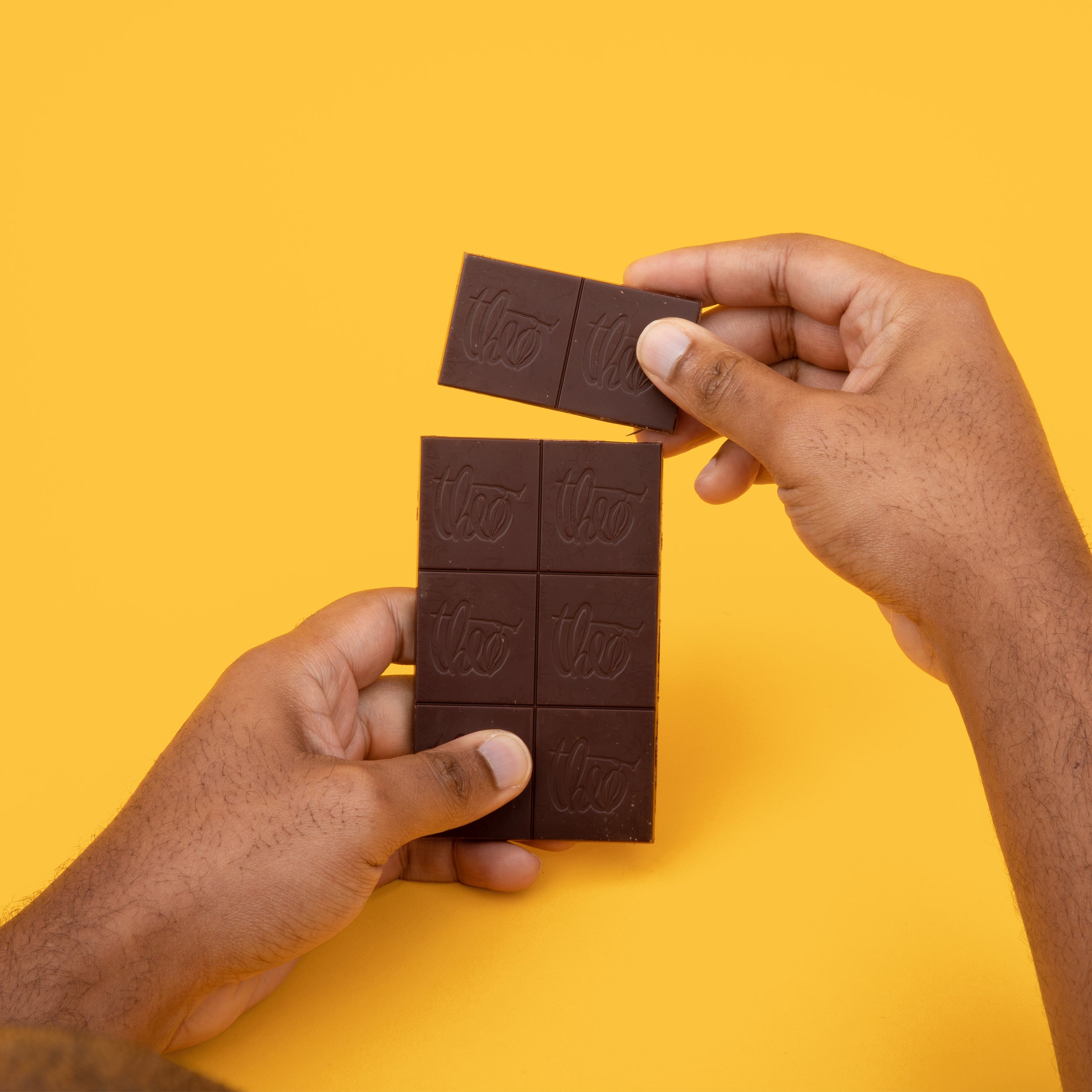
The form factor of the Truffle Bar line is visually reminiscent of an individually-wrapped KitKat™ finger. (I saw a lot of individually flow-wrapped KitKat fingers in paper boxes when I visited the Ginza (Tokyo) KitKat Chocolatory in early 2020.) None of the four Magic Truffle bars has wafers in them. Instead, the bars are either mono- or multi-layered with three of the four featuring variations on hazelnut inclusions. The chocolate has a texture that is closer to that of a gianduia than of a solid tempered chocolate, which is likely where the truffle allusion arises.
TL;DR Summary: Individually-wrapped KitKat flavors available at a Chocolatory tend to be very upscale, commanding prices as high as $3 per finger. In that context, Magic’s Truffle bar line is very competitively priced delivering two things KitKats (owned by Nestlé) and Twix™ (owned by Mars) do not: a satisfying chocolate flavor experience and textural variety from SKU to SKU. Experientially, Magic’s Truffle bars stand head-and-shoulders above KitKats and Twix while the flavors and textures remain accessible to adolescents and small children.
Parents can confidently serve their kids Magic Truffle bars knowing they are made with ingredients they can feel good about eating. And, apart from the hazelnuts, Magic Truffle bars are free from most common allergens (which is not a label claim).
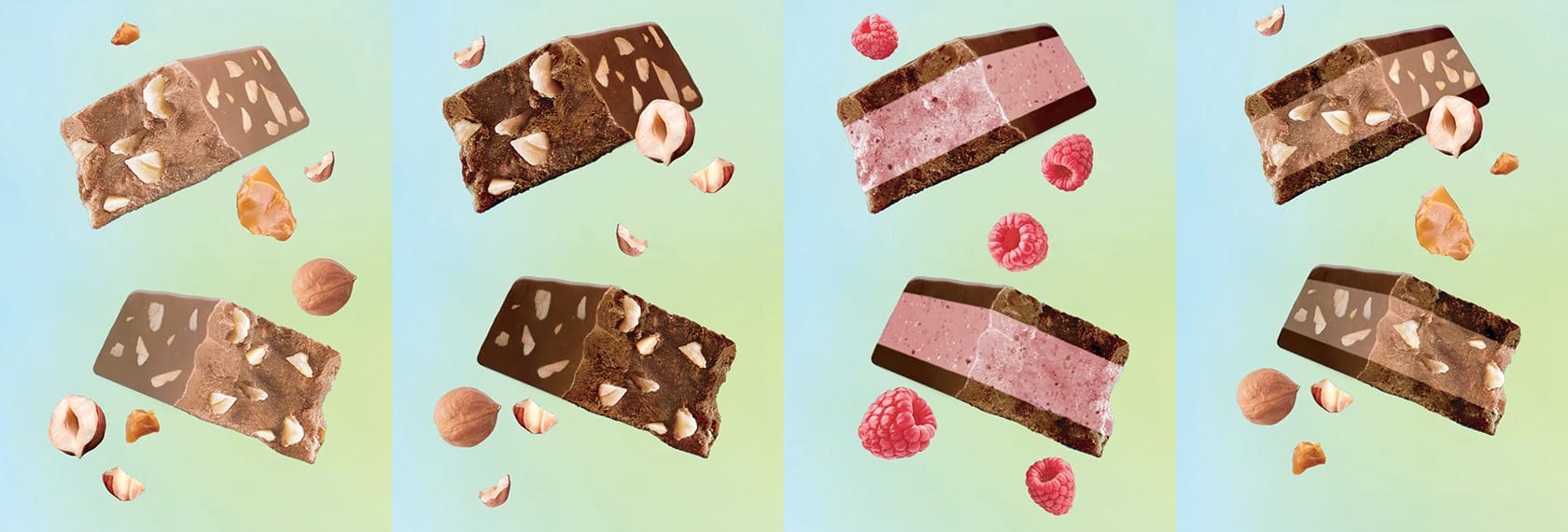
There are two expressions of the format: truffle bars and truffle layer bars. The truffle layer bars comprise three layers: a filling layer sandwiched between two chocolate layers, as can be seen in the photo lineup. The bars are not enrobed.
Each Magic Truffle bar weighs in at 22 grams and between 120-130 calories, depending on the flavor. (There are plans to expand the line to include 15 gram bars.)
Detailed Impressions (least favorite to most favorite):
- Creamy Raspberry Truffle Layer Bar. If you like Callebaut’s Ruby chocolate, you will definitely like this bar. The center, flavored filling layer, delivers the red-fruity, more-ish quality that makes Ruby chocolate Ruby. (To be clear, Ruby chocolate is not used in Magic Truffle bars; this is just a flavor analogy.) The outer two chocolate layers add depth and richness and cut the cloying sweetness that Ruby on its own exhibits. This bar caters to sophisticated adult tastes seeking a luxurious mouthfeel and consumers interested in portion control and clean ingredients, all while being very accessible to younger chocolate fans who don’t care one whit about those things. Warning: It’s really easy to finish this bar without being aware it’s gone because of its flavor and texture. Proceed at your own risk!
- Hazelnut Crunch (dark) Truffle Bar. This is the simplest of the three Magic Truffle bars with hazelnut inclusions. I have had many gianduiotti with hazelnut inclusions in Italy, so this is reminiscent of those, in a good way. The hazelnut pieces are roasted, but lack the candied layer and salt in the other variations. These are the simplest in flavor profile, not just ingredients. The hazelnuts add flavor, but more importantly, texture. The texture is likely to make you pay more attention to what you’re eating (it did for me), and I found myself savoring this bar rather than inhaling it.
- Salted Candied Hazelnut Truffle Bar. This bar is made with oat milk. I am generally not a fan of oat milk chocolate as it tends to have a distinctive taste I don’t care for. And, because oat milk has no fat, I usually find the bite, melt, and chew textures to be “off.” But that is not the case with this bar. It is very accessible to adults and children who want to avoid dairy milk. I prefer this one over the simpler dark bar because of the salt and candied hazelnut pieces. Anyone who’s been following me for any amount of time knows that I am a huge fan of adding salt to chocolate, either refined in, in a candying process, or as an inclusion or topping. This bar (and the next one) combines salty, crunchy, and candied components, and the texture of the hazelnuts.
- Salted Candied Hazelnut Truffle Layer Bar. This is the most complex and sophisticated of all of the Magic Truffle bars and that is because, in addition to the salt, crunchy, and candied components, the texture of the hazelnuts, there is the gianduia-like texture of the dark chocolate layers, making it richer than either the oat milk bar or the plain dark truffle bar.
Ratings
Using TheChocolateLife (modified seven-step) Tier List scale (SABOCDF, where S = I want this for my last meal; O = Ordinary; F= I would not eat this if gifted, I would not spend my own money on it, and I would not regift it to anyone whose opinions matter to me), my ratings for these bars are:
- Creamy Raspberry Truffle Layer Bar: B
- Hazelnut Crunch Dark Truffle Bar: B
- Salted Candied Hazelnut (Oat milk) Truffle Bar: B
- Salted Candied Hazelnut Truffle Layer Bar: B
While not “gourmet” in the strictest sense, Magic’s Truffle bars are solidly and thoughtfully sourced and are products that deserve your consideration, especially if conscious sourcing matters to you. They are tasty and accessible to a wide range of chocolate fans of all ages and flavor preferences, making them a very welcome alternative to more industrial candy bars from Big Chocolate makers such as Mars, Mondelēz, (which owns Hu), Nestlé, Lily’s (owned by Hershey), and other “ethical” brands, including and especially Tony’s Chocolonely (whose chocolate is manufactured by Callebaut).
The flavors and format are also more accessible than those of Alter Eco’s truffles (my review), and the non-truffle bars are tastier.
Concluding Thoughts
- If you are looking for a brand that tastes good and has the attributes I highlight in this review as pluses, Magic Chocolate’s products should be on your list to try. And while you might not like a specific chocolate bar or Truffle Bar, just as you might not be excited by this or that song by a musician you like, keep on sampling to discover the one(s) you do like.
- Ingredients – The ingredients list is limited and clean. However, I am not a fan of multi-certification, as it’s hard to demonstrate that the certifications deliver on their promises to farmers. (I also understand that the certification labels are not there for professionals like me.) Magic Chocolate, the company, is less than a year old, and I’d like to see more extensive reporting on impact, especially with respect to documenting what the premiums pay for and how farming farm families benefit. (For example, on their About Us page, the text “Learn about our mission and ROC farming practices” does not link to anywhere.)
- Demonstrated long-term commitment to enviromental and ethical sourcing concerns – especially when compared against brands commonly found in grocery outlets. Joe has been working on these issues for 30 years, at different scales, and this is his third rodeo. He knows the ropes and has a clear vision of where he wants to take the company.
- Being privately held means the company can resist pressure from outside investors to cut corners to boost profits and dividends (at least in the short term). Having a unique product line helps here.
- Production pedigree – I was not familiar with Maestrani before this review, even though I had eaten the original Dr Bronner’s bars. Maestrani was founded in the 1850s. Felchlin was founded in 1908 as an ingredient supplier and began manufacturing chocolate in the 1920s, introducing their Grand Cru line in the early 2000s.
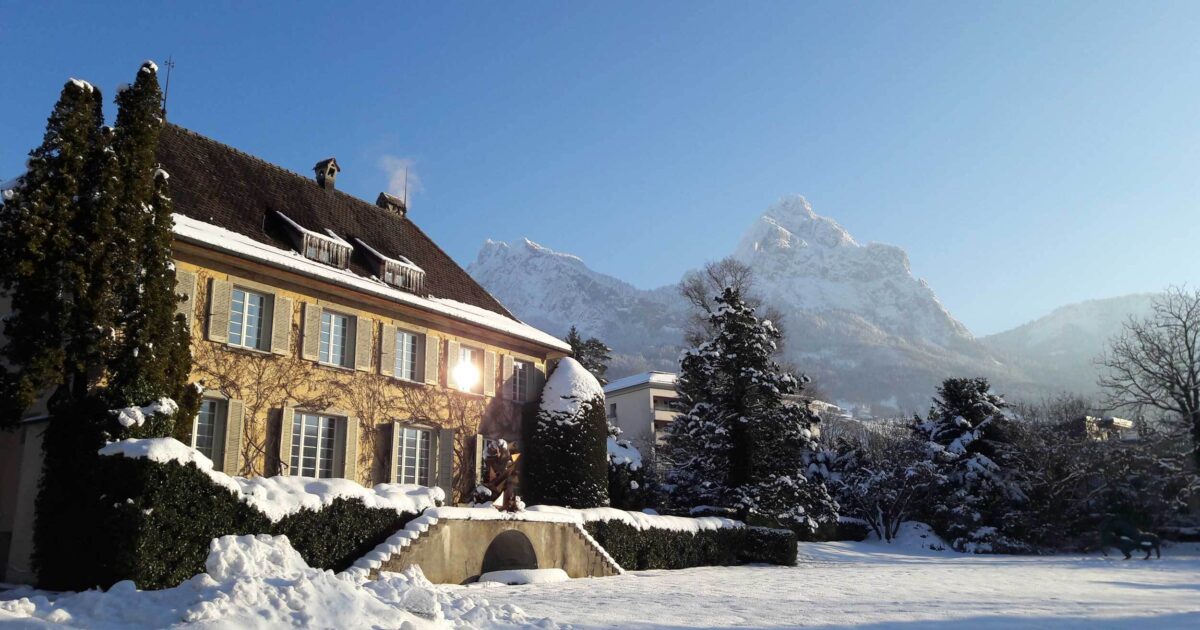
Disclaimer: My history with Felchlin goes back to the World Pastry Forum in Las Vegas in 2003. I was in Schwyz (where the Felchlin factory is located) in 2008 for the 100th anniversary of the company’s founding. In my opinion, Felchlin is right at the top of the top tier of chocolate makers in Switzerland. The first production year of Cru Sauvage (2006) – the first bar made from the wild beans from Hacienda Tranquilidad in Bolivia (and the first to receive HCP recognition) – still stands out in my mind as one of the, if not the, best chocolates I have ever eaten. - My Earliest History with Joe: During my hour-long interview with Joe for this review, we spent some time trying to figure out where we first met in person. While we might have met at an early Northwest Chocolate Festival in Seattle (the first NWCF was in 2008, after the founding of Theo), neither of us has a firm recollection of meeting there. In an email dated August 22, 2014, asking me to approve a quote for an article in Candy Industry Magazine: “Clay Gordon, whose ChocolateLife website provides a virtual gathering place for a worldwide conversation focused on chocolate, participated in a panel introduced by Joe Whinney of Theo Chocolates (Seattle).” We both remember meeting in Lima.
Links



 A’dae Romero-Briones(Cochiti/Kiowa) | Founding ROA Board Member
Regenerative Organic Certification (ROC) has a tiered structure that includes three levels: Bronze, Silver, and Gold. Each level signifies a different degree of compliance with the ROC standards. All levels emphasize soil health, animal welfare, and social fairness, but the extent and rigor of practices increase with each level.
###30###