Harkin-Engel at 25 | #PSC 232
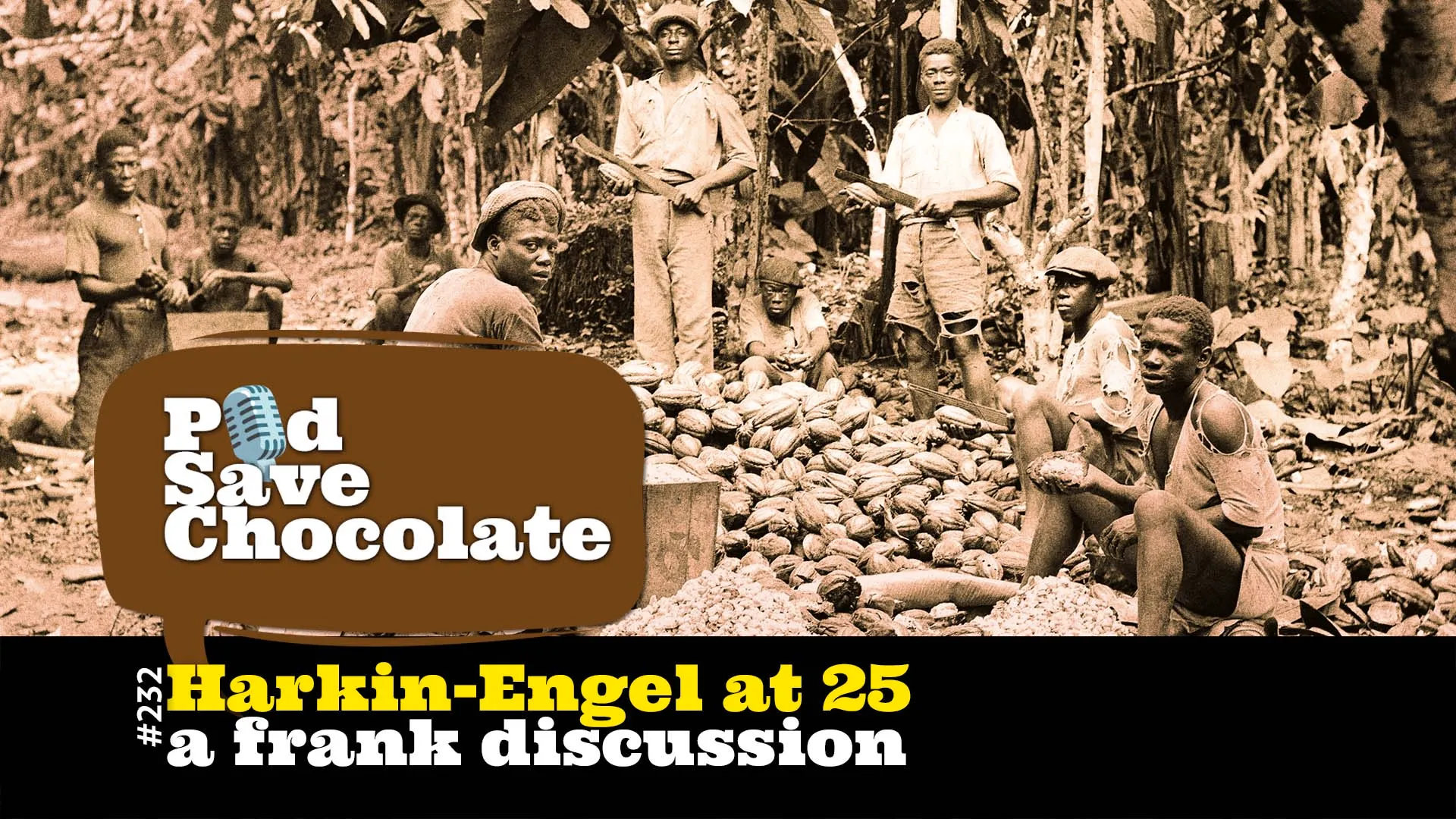
OVERVIEW: Episode 232 of #PodSaveChocolate explores twenty-five years of progress (lack thereof?) in eradicating illegal labor – including slavery – from cocoa. What’s standing in the way? [updated]
Click a link below to view the archived episode.

Watch and comment LIVE or view the archived episode!
Subscribe (free!) to the @PodSaveChocolate YouTube channel, like this video, comment, and share this episode to help grow the #PSC community.

Watch and comment LIVE or view the archived episode on LinkedIn.
Join my network on LinkedIn to receive notifications and to refer business to each other.

Watch and comment LIVE or view the archived episode on TheChocolateLife page on Facebook (for 30 days, then watch the archive on YouTube).
Follow TheChocolateLife on Facebook to receive notifications and catch up on other content.
Episode 232
In September 2001, under threat of a congressional bill, the CEOs of major US chocolate companies signed the Harkin-Engel Protocol, promising industry-wide standards to eliminate the worst forms of child labor in cocoa by July 1, 2005.
One nuance missed by many: The Harkin-Engel Protocol was never codified into federal law or regulation; it’s a voluntary joint statement signed by industry representatives, Senator Harkin, and Representative Engel on September 19th, 2001, and it lives in the private/NGO archival space, not in federal code.
The full name of the Protocol is: “PROTOCOL FOR THE GROWING AND PROCESSING OF COCOA BEANS AND THEIR DERIVATIVE PRODUCTS
IN A MANNER THAT COMPLIES WITH ILO CONVENTION 182
CONCERNING THE PROHIBITION AND IMMEDIATE ACTION FOR THE
ELIMINATION OF THE WORST FORMS OF CHILD LABOR,” and it is memorialized on Chocolate Manufacturers Association (“CMA”) letterhead.
The National Confectionery Association (NCA) and the Chocolate Manufacturers Association (CMA) merged in 2007.
Signatories and witnesses to the protocol include: The Chocolate Manufacturers Association; the World Cocoa Foundation; Senator Tom Harkin; Senator Herbert Kohl; Congressman Eliot Engel; Ambassador Youssoufou Bamba
(Embassy of the Ivory Coast); Mr. Frans Roselaers, Director, International Programme on the Elimination of Child Labour [IPEC], International Labor Organization (ILO); Ron Oswald, General Secretary, International Union of Food, Agricultural, Hotel, Restaurant, Catering, Tobacco and Allied Workers' Associations (IUI); Kevin Bales, Executive Director, Free The Slaves; Linda Golodner, President, National Consumers League; Darlene Adkins, National Coordinator, The Child Labor Coalition; Guittard; Mars; World’s Finest Chocolate; Archer Daniels Midland (ADM); Nestlé (USA); Blommer; Hershey; and Barry Callebaut AG.
The “as close to an official version as appears to exist” is hosted by the International Cocoa Initiative (“ICI”), the organization that grew directly out of the Protocol’s oversight mechanism, at the link below.

In 2010, a Framework of Action to Support Implementation of the Harkin-Engel Protocol was agreed to.
The “as close to an official version as appears to exist” contains a duplicate page for some reason.
 Contributors to Wikimedia projects
Supreme Court Amicus Briefs in Support of Respondents in Nestle v. Doe
Corporate Accountability Lab filed two amicus briefs in support of Respondents in the Nestle v. Doe case before the US Supreme Court, both about corporate liability under the Alien Tort Statute (ATS). CAL filed the two briefs on behalf of nineteen cocoa and chocolate companies that have structured their companies so that they source only slave-free cocoa.
Some History
The 2005 deadline was missed. So was the next one, in 2008. So was the one after that, in 2010. In 2010 the industry didn’t just extend the deadline, they quietly moved the goalposts: from eliminating child labor entirely to reducing the worst forms of it by 70% by 2020. Which deadline they also missed.
- The National Opinion Research Center (“NORC”) at the University of Chicago ran the largest-ever survey of the sector for the U.S. Department of Labor. Their October 2020 brief states plainly: from 2008/09 to 2018/19, cocoa production in Côte d'Ivoire and Ghana rose 62%, and during that period, child labor rose 14%, and hazardous child labor rose 13%.
NORC: Child Labor in Cocoa Production in Côte d'Ivoire & Ghana - An investigation published in the Washington Post in 2019 added a traceability angle: at the time, Mars could trace only 24% of its cocoa to farms, Hershey less than half, Nestlé 49%. Its framing of the two-decade record: "Hershey, Nestle and Mars broke their pledges to end child labor in chocolate production."
1) Washington Post, 2019
2) Washington Post, October 2020: Child labor on the rise in cocoa industry despite years of company promises to stop it
The National Confectioners Association (NCA) supports the Harkin-Engel Protocol, which aims to eliminate child labor in cocoa production. They advocate for responsible sourcing and transparency in the chocolate supply chain to ensure ethical practices. NCA also promotes initiatives that align with these goals.
Hershey (current sustainability page): “We aim to eliminate child labor in our supply chain by working with governments, suppliers and farming communities to prevent and remediate issues.” Backed by a ‘12-year, $500 million investment,’ with 105,099 farmers supported as of its 2024 RBR report.
Hershey: Cocoa
Mars (Cocoa for Generations page): “Our goal by 2025: Through our suppliers, to implement robust child labor and forced labor monitoring and remediation systems for 100% of at-risk families in our cocoa supply chains.” Mars also estimated it would need to reach “more than 150,000 cocoa farming households with an estimated 500,000 children.”
Mars: Responsible Cocoa Today
Nestlé USA (FAQ page): “By 2025, we are committed to be able to trace all cocoa back to a specific group of farms and ensure 100% of the cocoa we use is sourced within our sustainability cocoa program.” The FAQs also state that roughly 128,000 children have been “protected against the risk of child labor since 2012.”
Nestlé USA: How is Nestlé tackling child labor risk?
- All of the “by 2025” pledges are past due.
- It’s September 2026 and I could not find a single company statement confirming whether Mars, Hershey, or Nestlé actually hit their 2025 traceability or CLMRS coverage targets.
Guests in the live stream
Charity Ryerson – Founder/Executive Director, Corporate Accountability Lab
 Home
Home
Corporate Accountability Lab on LinkedIn.

Terry Collingsworth, the Executive Director of IRA, was originally scheduled to appear but a conflict makes that impossible. Charity Ryerson of Corporate Accountability Lab will appear in Terry’s stead.
Miki Mistrati – Producer/Filmmaker

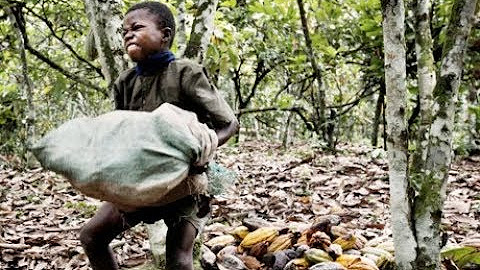
A playlist of three videos produced by Miki Mistrati (The Dark Side of Chocolate, Shady Chocolate, and The Chocolate War), and our interview. More videos by and about Miki on YouTube.
The DP for The Dark Side of Chocolate was U. Roberto (Robin) Romano, who is also known for the documentary The Harvest (la Cosecha), which was released in 2010.
I was fortunate to have had the opportunity to work with Robin before his passing in 2013.
Bright Adjei Debrah – Founder, ICRAWE (Ghana)

Podcast guest Bright Adjei Debrah is a founder of ICRAWE.
Featured Image
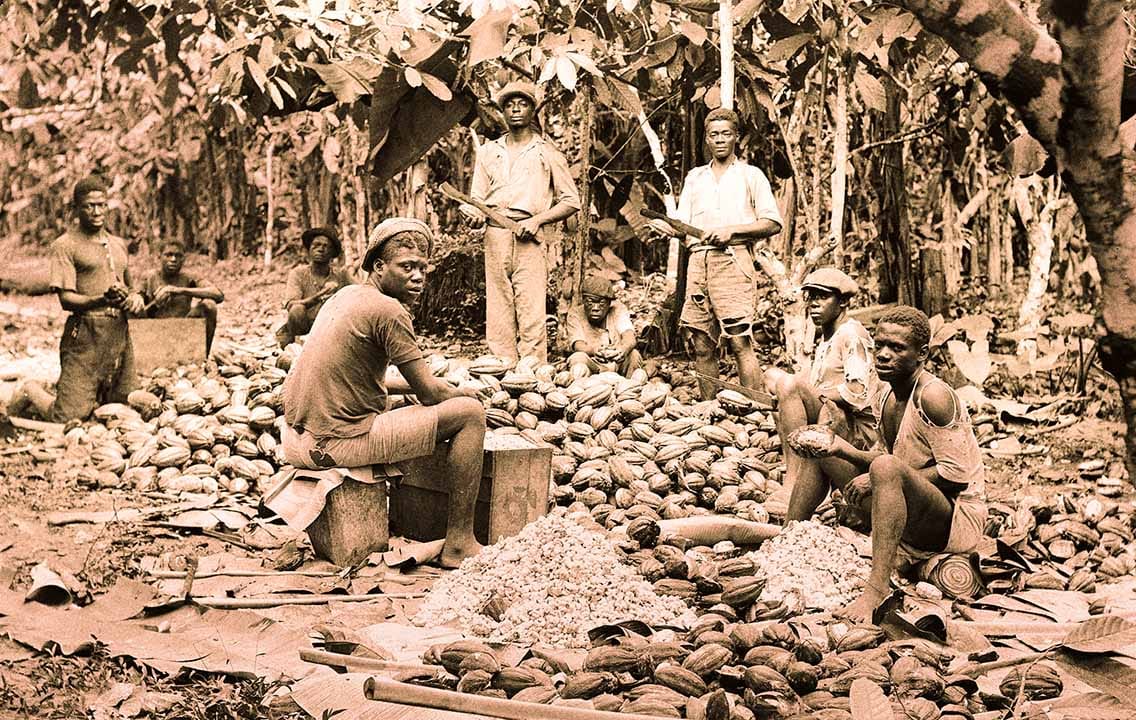
The photo is believed to be from the late 1800’s, at a cocoa plantation whose location was not recorded. It’s unknown if the image is of workers after the abolition of slavery in the colonies, or if the people picture are indeed (still) slaves.
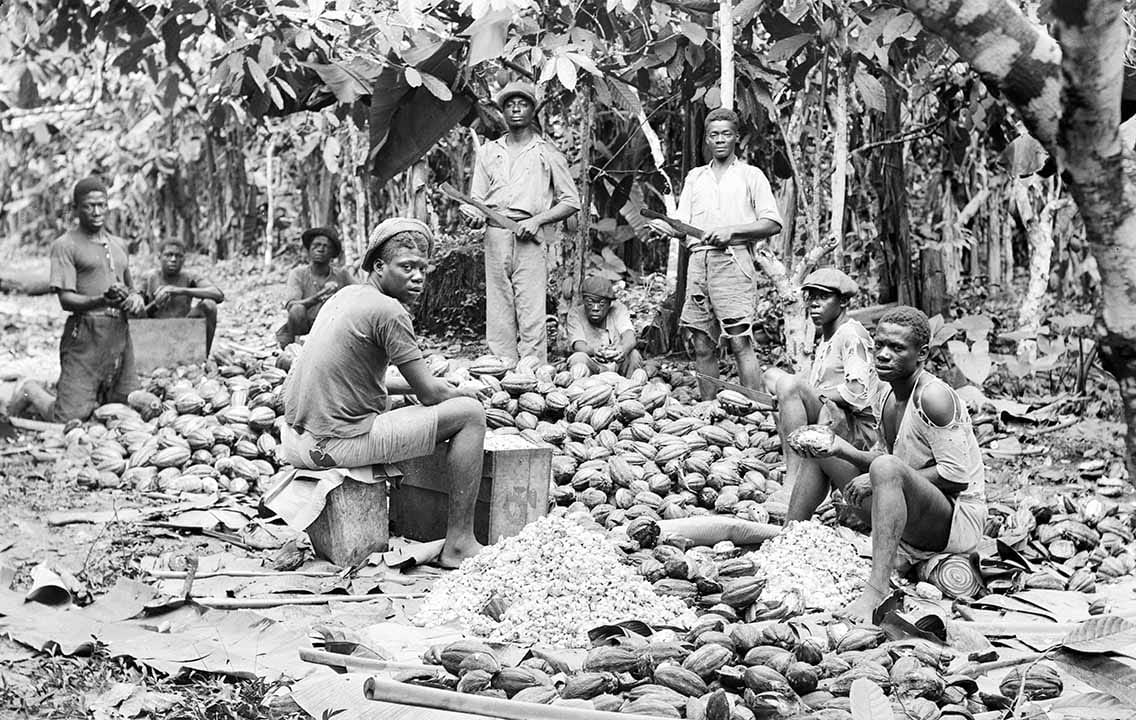
[L] Original; [R] After editing. Although some changes are very subtle, by the use of a calculated 3D map I was able to change the lighting in the scene to add an illusion of depth that is not in the original.
Future Episodes
Change.org / FDA Citizen petition
Monthly member AMA call (link in the September member newsletter).
Episode Hashtags
#cocoa #cacao #cacau
#chocolate #chocolat
#PodSaveChoc #PSC
#LaVidaCocoa #TheChocolateLife
#PodSaveChocolate and #TheChocolateLifeLIVE Archives
To read an archived post and find the links to watch archived episodes, click on one of the bookmark cards below.
 Clay Gordon
Episodes 201-300 (links to older PSC archives are in the top nav).
Clay Gordon