(Standards of) Identity (Theft) | #PSC 238
OVERVIEW: Episode 238 of #PodSaveChocolate takes a look at how the standards of identity for cacao products can be chipped away at, bit by bit, leading to unwanted changes, invisibly.
Timing and Links to Watch & Comment
Links below to watch LIVE and to view the archived episode.

Watch and comment LIVE or view the archived episode!
Subscribe (free!) to the @PodSaveChocolate YouTube channel, like this video, comment, and share this episode to help grow the #PSC community.

Watch and comment LIVE or view the archived episode on LinkedIn.
Join my network on LinkedIn to receive notifications and to refer business to each other.

Watch and comment LIVE or view the archived episode on TheChocolateLife page on Facebook (for 30 days, then watch the archive on YouTube).
Follow TheChocolateLife on Facebook to receive notifications and catch up on other content.
Episode 238
Many people who write about chocolate have never read the law that details what chocolate is.
In the US, "chocolate" is a legal term with a raw material at its center, and the pressure to loosen that definition is coming from several directions at once. If you do not know the standard exists, you are writing about your idea of chocolate, not about chocolate.
In this episode I will walk you through the standards and ask, “Who gets to change them?”
 Part 163
The standards of identity for “cacao products” aka chocolate. Worth reading if you love chocolate.
The timing of this episode is intentional: On September 15th TheChocolateLife published a Change.org petition asking FDA not to amend 21 CFR Part 163 so that products made with engineered cocoa substitutes can be labeled “chocolate.”
 Clay Gordon
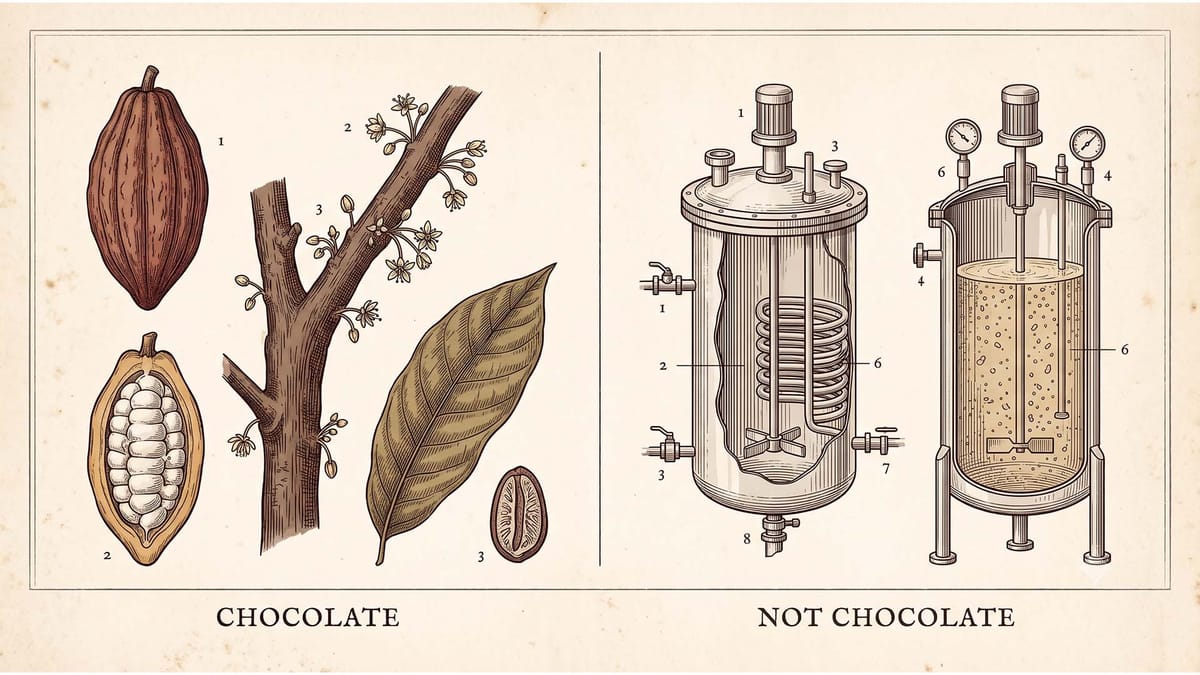
A related change is the FDA's final rule on salt substitutes (Federal Register, October 13, 2026, effective December 14, 2026), which adds salt substitute as an optional ingredient in five Part 163 standards: chocolate liquor, breakfast cocoa, sweet chocolate, white chocolate, and milk chocolate.
This shows how the standards actually get edited: one narrow paragraph at a time, for reasons that have nothing to do with chocolate.
A TL;DR Look at Key Elements of 21 CFR Part 163
Product | Section | Core requirement |
|---|---|---|
Cacao nibs | 163.110 | Shell removed from cured, cleaned, dried, cracked cacao beans; shell not more than 1.75% |
Chocolate liquor | 163.111 | Finely ground cacao nibs; cacao fat 50 to 60% by weight |
Sweet chocolate | 163.123 | At least 15% chocolate liquor; milk solids under 12% |
Semisweet or bittersweet | 163.123 | At least 35% chocolate liquor |
Milk chocolate | 163.130 | At least 10% chocolate liquor, 3.39% milkfat, and 12% total milk solids |
White chocolate | 163.124 | At least 20% cacao fat, 3.5% milkfat, 14% total milk solids; no more than 55% nutritive sweetener; no coloring |
Sweet chocolate and vegetable fat coating | 163.153 | Vegetable fats other than cacao fat allowed (may be hydrogenated); must be named as a coating |
The rules are short, specific, and built on ingredients, not on process or provenance.
White chocolate has its own standard, with a cacao fat floor. The term “milk chocolate” is tied to a milkfat and milk solids floor, and a lower-milkfat product must be called something else, such as skim milk chocolate (163.140) or buttermilk chocolate (163.135). Vegetable-fat versions exist inside the same Part, but they must carry the word “coating” in the name.
Comparing Key Elements of 21 CFR Part 163 and the Codex Alimentarius
The international reference is CXS 87-1981, Standard for Chocolate and Chocolate Products. It was adopted in 1981, revised in 2003, and amended in 2016, 2022, and 2025, with a 2026 errata (miscellaneous corrections) update.
Product | Codex (dry matter basis) | US Part 163 |
|---|---|---|
Chocolate | At least 35% total cocoa solids, 18% cocoa butter, 14% fat-free cocoa solids | Defined by product type, starting from chocolate liquor percentages |
Sweet chocolate | At least 30% total cocoa solids | At least 15% chocolate liquor |
Milk chocolate | At least 25% cocoa solids; milk solids 12 to 14%; milkfat 2.5 to 3.5% | At least 10% chocolate liquor, 3.39% milkfat, 12% milk solids |
White chocolate | At least 20% cocoa butter; at least 14% milk solids | At least 20% cacao fat, 3.5% milkfat, 14% milk solids |
Other vegetable fat | Up to 5% of the finished product allowed, if labeled | Appears only in the separate "coating" standards |
It is not possible to read the percentages across the rows as like for like. Codex measures on a dry matter basis, and the US calculates chocolate liquor by a formula that leaves out cacao fat, alkali, and flavorings. Thinking they talk about the same thing – and translating the differences – can make ones brain hurt.
Codex lets up to 5% of the finished product be vegetable fat other than cocoa butter, provided the minimum cocoa content holds and the label says so (Section 5.1.1). The US puts non-cacao fats in a separate coating category with a different name.
In the Episode ...
I will introduce three other cases where the rules can be stretched: the standards do their job at the front of the package; the stretching happens in the gaps around them.
And why this matters.
I will also spend time in this section talking about who decides – regulators or chocolate makers, as well as discuss some pros and cons of the position the Change.org petition argues for.
Other Standards
- England: The Cocoa and Chocolate Products (England) Regulations 2003, SI 2003/1659: legislation.gov.uk/uksi/2003/1659. The page applies to England only.
- Scotland: The Cocoa and Chocolate Products (Scotland) Regulations 2003, SSI 2003/291: legislation.gov.uk/ssi/2003/291.
Canada splits the rules across two places.
- Compositional standards: Canadian Food Compositional Standards, Volume 4 (Cocoa and Chocolate Products), from the CFIA. It is incorporated by reference into the Food and Drug Regulations.
- Labelling: the CFIA’s confectionery, chocolate and snacks labeling guide covers the standardized common names.
Future Episodes
2026 AVPA Chocolate Processed at Origin Awards
Episode Hashtags
#cocoa #cacao #cacau
#chocolate #chocolat
#PodSaveChoc #PSC
#LaVidaCocoa #TheChocolateLife
#PodSaveChocolate and #TheChocolateLifeLIVE Archives
To read an archived post and find the links to watch archived episodes, click on one of the bookmark cards below.
 Clay Gordon
Episodes 201-300 (links to older PSC archives are in the top nav).
Clay Gordon