(Standards of) Identity (Theft) | #PSC 238
OVERVIEW: Episode 238 of #PodSaveChocolate takes a look at how the standards of identity for cacao products can be chipped away at, bit by bit, leading to unwanted changes, invisibly. [Updated]
Timing and Links to Watch & Comment
Links below to watch LIVE and to view the archived episode.

Watch and comment LIVE or view the archived episode!
Subscribe (free!) to the @PodSaveChocolate YouTube channel, like this video, comment, and share this episode to help grow the #PSC community.

Watch and comment LIVE or view the archived episode on LinkedIn.
Join my network on LinkedIn to receive notifications and to refer business to each other.

Watch and comment LIVE or view the archived episode on TheChocolateLife page on Facebook (for 30 days, then watch the archive on YouTube).
Follow TheChocolateLife on Facebook to receive notifications and catch up on other content.
Episode 238
Many people who write about chocolate have never read the law that details what chocolate is.
In the US, "chocolate" is a legal term with a raw material at its center, and the pressure to loosen that definition is coming from several directions at once. If you do not know the standard exists, you are writing about your idea of chocolate, not about chocolate.
In this episode I will walk you through the standards and ask, “Who gets to change them?”
 Part 163
The standards of identity for “cacao products” aka chocolate. Worth reading if you love chocolate.
The timing of this episode is intentional: On September 15th TheChocolateLife published a Change.org petition asking FDA not to amend 21 CFR Part 163 so that products made with engineered cocoa substitutes can be labeled “chocolate.”
 Clay Gordon
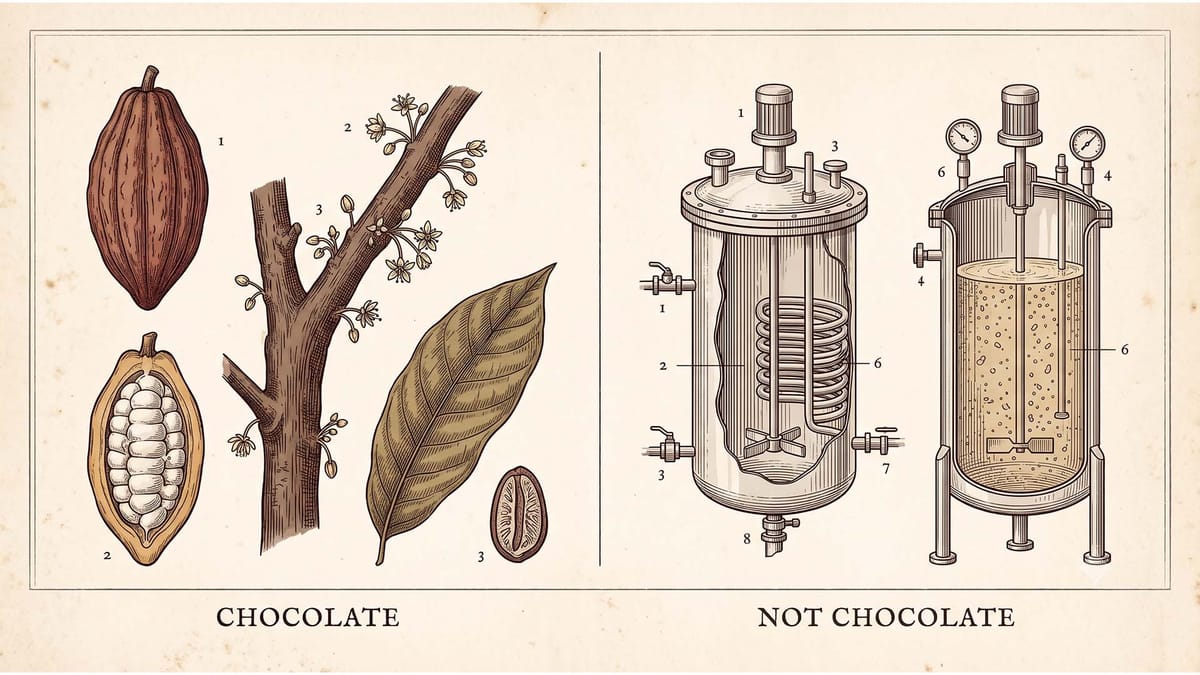
A related change is the FDA's final rule on salt substitutes (Federal Register, October 13, 2026, effective December 14, 2026), which adds salt substitute as an optional ingredient in five Part 163 standards: chocolate liquor, breakfast cocoa, sweet chocolate, white chocolate, and milk chocolate.
This shows how the standards actually get edited: one narrow paragraph at a time, for reasons that have nothing to do with chocolate.
Why salt is a different kind of change
The rule changes paragraph (b), the optional ingredients, in five standards: 163.111, 163.112, 163.123, 163.124, and 163.130. It leaves paragraph (a), the definition, alone. Chocolate liquor is still “the solid or semi-plastic food prepared by finely grinding cacao nibs.”
Salt substitutes only add an optional ingredient, at a trace level, to a food whose identity is untouched.
An engineered cocoa substitute would do the opposite. It would swap out the thing paragraph (a) defines.
A salt substitute must replace “some or all of the added salt,” reduce sodium, and serve “the functions of salt in the food.” That is a functional-equivalence test, and a proponent of cocoa substitutes would copy its shape: “an ingredient that serves the functions of cacao.” The test fits salt because salt’s functions are narrow and can be listed. Cacao is the identity-defining ingredient and carries flavor, color, fat crystallization, and melt at once.
The FDA says the rule keeps “the basic nature and essential characteristics” of the foods and “does not permit the use of any ingredients or substances that are not already permitted in non-standardized foods.”
The salt rule shows that the FDA will rewrite a cacao standard when the change is narrow, functional, and framed around “honesty and fair dealing” under section 401. Part 130.5(b) puts that same test on any petition for a food standard. A proponent would have to argue that a cocoa-free product, named honestly, meets it. My position is that the definitional change makes the name dishonest, whatever the label says.
Just Mayo (2015). The FDA’s warning letter said the name and egg image could lead consumers to think the product was mayonnaise, “which must contain eggs.” The product contained no eggs and used an ingredient the standard did not permit. The standard held, and the egg-free product was pushed toward a different name.
A 2005 modernization proposal. A joint FDA/USDA proposal on general principles for revising or revoking standards drew industry comments that named milk chocolate as a candidate for revision
A TL;DR Look at Key Elements of 21 CFR Part 163
Product | Section | Core requirement |
|---|---|---|
Cacao nibs | 163.110 | Shell removed from cured, cleaned, dried, cracked cacao beans; shell not more than 1.75% |
Chocolate liquor | 163.111 | Finely ground cacao nibs; cacao fat 50 to 60% by weight |
Sweet chocolate | 163.123 | At least 15% chocolate liquor; milk solids under 12% |
Semisweet or bittersweet | 163.123 | At least 35% chocolate liquor |
Milk chocolate | 163.130 | At least 10% chocolate liquor, 3.39% milkfat, and 12% total milk solids |
White chocolate | 163.124 | At least 20% cacao fat, 3.5% milkfat, 14% total milk solids; no more than 55% nutritive sweetener; no coloring |
Sweet chocolate and vegetable fat coating | 163.153 | Vegetable fats other than cacao fat allowed (may be hydrogenated); must be named as a coating |
The rules are short, specific, and built on ingredients, not on process or provenance.
White chocolate has its own standard, with a cacao fat floor. The term “milk chocolate” is tied to a milkfat and milk solids floor, and a lower-milkfat product must be called something else, such as skim milk chocolate (163.140) or buttermilk chocolate (163.135). Vegetable-fat versions exist inside the same Part, but they must carry the word “coating” in the name.
Comparing Key Elements of 21 CFR Part 163 and the Codex Alimentarius
The international reference is CXS 87-1981, Standard for Chocolate and Chocolate Products. It was adopted in 1981, revised in 2003, and amended in 2016, 2022, and 2025, with a 2026 errata (miscellaneous corrections) update.
Product | Codex (dry matter basis) | US Part 163 |
|---|---|---|
Chocolate | At least 35% total cocoa solids, 18% cocoa butter, 14% fat-free cocoa solids | Defined by product type, starting from chocolate liquor percentages |
Sweet chocolate | At least 30% total cocoa solids | At least 15% chocolate liquor |
Milk chocolate | At least 25% cocoa solids; milk solids 12 to 14%; milkfat 2.5 to 3.5% | At least 10% chocolate liquor, 3.39% milkfat, 12% milk solids |
White chocolate | At least 20% cocoa butter; at least 14% milk solids | At least 20% cacao fat, 3.5% milkfat, 14% milk solids |
Other vegetable fat | Up to 5% of the finished product allowed, if labeled | Appears only in the separate "coating" standards |
It is not possible to read the percentages across the rows as like for like. Codex measures on a dry matter basis, and the US calculates chocolate liquor by a formula that leaves out cacao fat, alkali, and flavorings. Thinking they talk about the same thing – and translating the differences – can make ones brain hurt.
Codex lets up to 5% of the finished product be vegetable fat other than cocoa butter, provided the minimum cocoa content holds and the label says so (Section 5.1.1). The US puts non-cacao fats in a separate coating category with a different name.
In the Episode ...
I will introduce other cases where the rules can be stretched: the standards do their job at the front of the package; the stretching happens in the gaps around them.
And why this matters.
I will also spend time in this section talking about who decides – regulators or chocolate makers, as well as discuss some pros and cons of the position the Change.org petition argues for.
- Reformulate, then rename. Cocoa prices rose dramatically during 2024 on climate trouble in West Africa, and Hershey told investors in February 2025 it was ready to adjust recipes. By February 2026, Food & Wine reported that several products had moved from “milk chocolate” to “chocolate candy” or to a crème: Reese's Mini Hearts, Mr. Goodbar, Reese’s Take5, and Fast Break among them. Hershey said the classic Reese's Peanut Butter Cup is unchanged BUT acknowledged “product recipe adjustments” on newer, seasonal, and shaped items. This is the standard working as designed: the front-of-package name is a legal statement of identity, and the product lost the right to the milk chocolate name. BUT ...
- The chocolate that is really cocoa. FDA’s Compliance Policy Guide Sec. 515.800, issued in May 1988, lets a non-standardized food use the plain word “chocolate” if its only chocolate flavoring is a 21 CFR Part 163 cacao ingredient, or if cocoa is the flavoring and consumers long recognize the food as cocoa-based (chocolate pudding is FDA’s example). Otherwise it must say “chocolate flavored.”
- The cocoa-free product that is not yet called chocolate. On May 28, 2026, FoodNavigator reported that Barry Callebaut was showing ChoViva, a sunflower-seed-based “‘cocoa-free’ ‘chocolate’” developed with Planet A Foods, to North American brands. The article does not say how it will be labeled in the US, and it does not mention the standards of identity. That gap is the question for the episode – and my Change.org petition.
- Words with no legal definition. “Bean-to-bar,” “craft,” and “artisan” appear nowhere in the Part 163 section list. The position of TheChocolateLife is that a term nobody defines cannot separate a two-person shop from a conglomerate.
- The case for keeping the raw-material anchor. Our Change.org petition argues that Part 163 defines chocolate by its source, that admitting non-cacao inputs would structurally change the definition, and that lab tests for cocoa butter would lose their reference point. It also notes the imitation-food rule in 21 CFR 101.3(e) applies only to nutritionally inferior substitutes, which could leave a nutritionally equivalent engineered product uncovered.
- The process question. A citizen petition under 21 CFR 10.30: if this goes to FDA, who files comments, and who is missing from the room? Cocoa farmers and cooperatives in producing countries are the obvious absent voices, and their interests may not line up with either camp.
Other Standards
- England: The Cocoa and Chocolate Products (England) Regulations 2003, SI 2003/1659: legislation.gov.uk/uksi/2003/1659. The page applies to England only.
- Scotland: The Cocoa and Chocolate Products (Scotland) Regulations 2003, SSI 2003/291: legislation.gov.uk/ssi/2003/291.
Canada splits the rules across two places.
- Compositional standards: Canadian Food Compositional Standards, Volume 4 (Cocoa and Chocolate Products), from the CFIA. It is incorporated by reference into the Food and Drug Regulations.
- Labelling: the CFIA’s confectionery, chocolate and snacks labeling guide covers the standardized common names.
Additional Links Mentioned
 Rachel Handler

Sign up for the free trial to read. As I mentioned in the episode, this is one of the best-written articles on chocolate I have read from someone who is not an expert in chocolate.


Looking for a gift for yourself or to take to Thanksgiving? Try the 16-piece Mignardise box.
As I mentioned at length in the episode, inspiration for portions of it arose out of discussions with Mona Changaris, the founder of Amore di Mona. They’ve been making common-allergen-free products since 2011.
Amore di Mona is a Team TCL Guru member of TheChocolateLife, and I have known Mona since 2015 when we met during The Big Chocolate Show in Manhattan. We did not discuss my comments before the episode began, however I did notify her that our conversations inspired portions of the episode.
Future Episodes
2026 AVPA Chocolate Processed at Origin Awards
Interview with Brad Reese
Episode Hashtags
#cocoa #cacao #cacau
#chocolate #chocolat
#PodSaveChoc #PSC
#LaVidaCocoa #TheChocolateLife
#PodSaveChocolate and #TheChocolateLifeLIVE Archives
To read an archived post and find the links to watch archived episodes, click on one of the bookmark cards below.
 Clay Gordon
Episodes 201-300 (links to older PSC archives are in the top nav).
Clay Gordon