Hot Take: MrBeast “Builds a City”? | #PSC 235
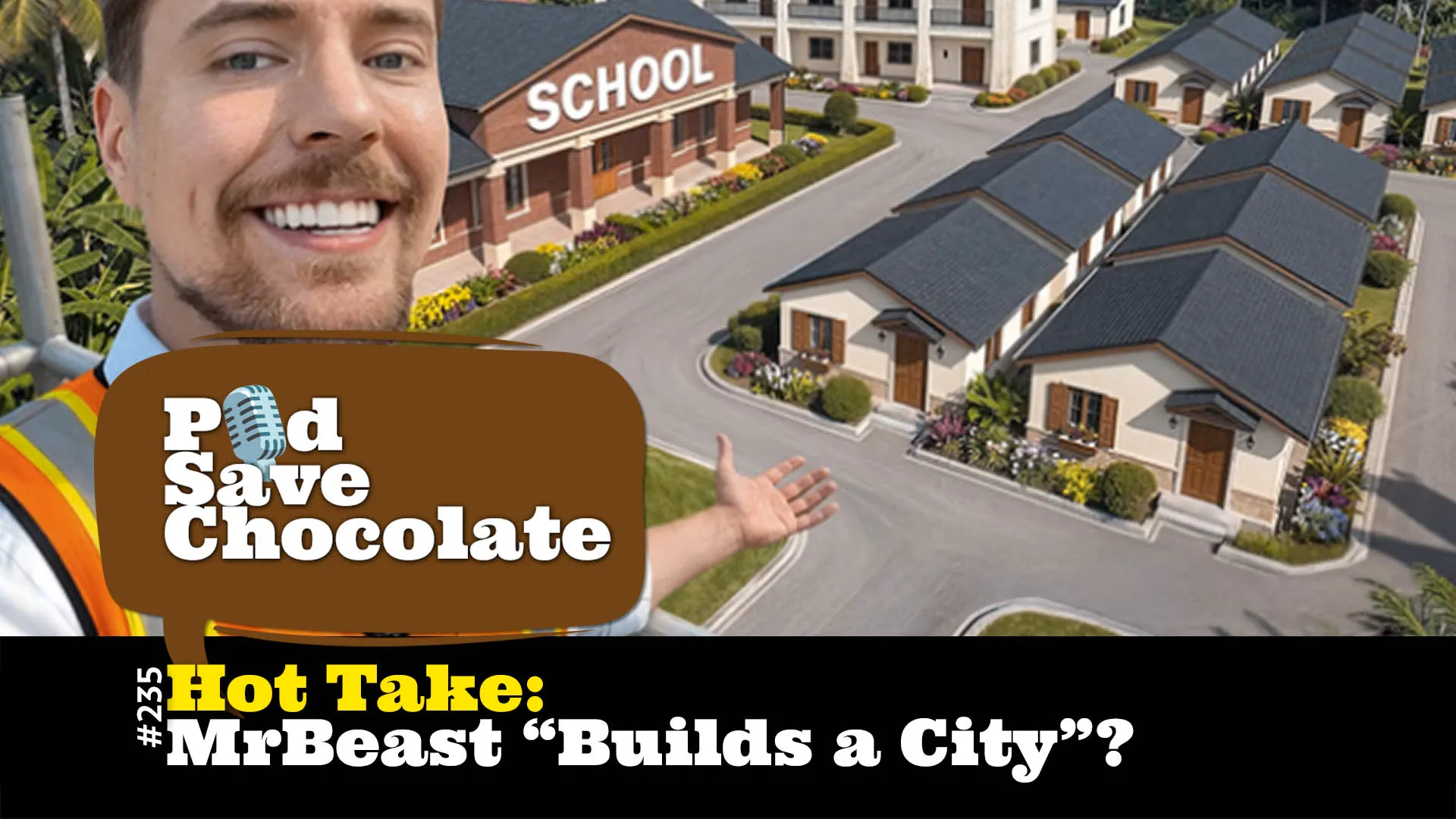
OVERVIEW: Episode 235 of #PodSaveChocolate takes a critical look – the first I can see from searching press on the project – on Jimmy Donaldson’s project to “Eradicate Child Labor in the Cocoa Industry in West Africa”.
Timing and Links to Watch & Comment
Links below to watch LIVE and to view the archived episode.

Watch and comment LIVE or view the archived episode!
Subscribe (free!) to the @PodSaveChocolate YouTube channel, like this video, comment, and share this episode to help grow the #PSC community.

Watch and comment LIVE or view the archived episode on LinkedIn.
Join my network on LinkedIn to receive notifications and to refer business to each other.

Watch and comment LIVE or view the archived episode on TheChocolateLife page on Facebook (for 30 days, then watch the archive on YouTube).
Follow TheChocolateLife on Facebook to receive notifications and catch up on other content.
Episode 235 Overview
This episode of #PodSaveChocolate takes a critical look at a MrBeast video with over 85 million views in 12 days. (Note: MrBeast’s YT channel has 513 million subscribers.)
The title of the video is I Built A City To Save Kids from Illegal Labor. Key elements of that statement will be evaluated and placed within the much larger context of what the scale of the problem Jimmy is attempting to solve.
Why am I doing this?
Because it doesn’t look like anyone else has. I can’t find a single article that does much more than echo press releases – not even from the “mainstream confectionery news” outlets.
The TL;DR: Hot Take:
What MrBeast’s enterprise has built is not a city – not even a village – and nothing like what the video thumbnail implies. [See the table below for more detail.]
The model for rescuing 1.5 million children from illegal child labor (MrBeast Announces Feastables Strategy to Eradicate Child Labor in the Cocoa Industry in West Africa) is not scalable.
The real work is price, monitoring (CLMRS), and meals, co-funded and operated by uncredited partners … and made possible by the Big Chocolate supply chain it attacks.
Before I Begin
A ChocolateLife Premium member I corresponded with (before I committed to doing this episode) asked why I was so skeptical about Mr Beast’s efforts in this area; shouldn’t I cut Jimmy some slack for raising awareness of the issue of illegal child labor in cocoa in W Africa?
That’s a fair question. Some thoughts.
- Timing. The video was published on September 19th, the 25th Anniversary of the signing of the Harkin-Engel Protocol. I don’t see this as a coincidence.
- Barry Callebaut is likely the (undisclosed) company that transforms the Tony’s Open Chain beans into chocolate. BC is one of the original signatories to Harkin-Engel.
- The International Cocoa Initiative (“ICI”), a Feastables partner, was created by industry in response to Harkin-Engel to eradicate “the worst forms of child labor” in cocoa by 2005. The ICI originated the CLMRS that Feastables points to.
- Fairtrade International is a part of the “certification industrial complex” that relies on the problem’s continued existence to maintain relevance and justify its own existence.
- Tony’s Open Chain is anything but open. Feastables is inseparable from Tony’s and relies on their goodwill as the basis for their own.
The actors above have all been complicit in the industry’s failure to fix the child labor problems they committed to (in one way or another) and/or were founded to fix.
Yet, here they are, anchoring the claims made for why Mr Beast should be trusted to fix the problem. However –
- The model fails immediately under even moderately close examination (which Jimmy knows his followers will not do). As promoted, the scheme cannot scale and it does not address fundamental issues, such as climate-change driven by deforestation, and it does not account for the replacement cost of labor.
- Feastables stands to gain much, much more than cocoa farmers in W Africa do.
Themes I Examined
What is actually being built?
What is shown in the video is not a city, or even a village. It’s a school campus with teacher housing and shared services, built on a field next to an existing community in Ghana.
| What | Detail | Who it serves |
|---|---|---|
| School | 10 classrooms, fans, electricity, desks, library; "over 300" students (325 in the old building) | Children |
| Houses | 10, furnished, rooftop solar, given "100% free" (legal title unclear) | Teachers relocated to the site |
| Water | Solar-pumped wells, two tower tanks, piped to homes | Village |
| Power | Off-grid solar, solar streetlights | Village |
| Drainage | Two 4 ft culverts replacing a 3 ft pipe at the river crossing | Access between the two halves of the community |
| Food | Farm, irrigation, fish tanks (aquaponics), chicken coop (~120 eggs/day) | Community |
| Community center | Library, medical center | Community |
| Market, toilets, football field, playground | — | Community |
The video shows one village – the project is larger:
| Community | Population | Child labor band | Teacher housing |
|---|---|---|---|
| 1 (described as "the hub") | ~4,600 | High | Yes |
| 2 | ~1,843 | Very High | No |
| 3 | ~1,060 | High | Yes |
| 4 | ~1,650 | High | No |
| 5 | ~890 | Extreme | No |
Other themes:
- Who is footing the bill? (Following the money.)
- What are the long-term maintenance and support commitments?
- Who is currently manufacturing Feastables chocolate?
This is unclear, but needs to be – the entire supply chain should be made public. As a Tony’s Open Chain partner it is possible that the chocolate is being manufactured by Barry Callebaut at its factory in Wieze, Belgium and shipped to processing partners in the US and EU that deposit and wrap the bars. Previously, Feastables sourced their cocoa in Peru and the manufacturer was Machu Picchu Foods (Lima). - How does this scale (can it scale?) from 300 to 1.5 million children?
- What the video doesn’t say
- Press credulity
Following the money
- The biggest beneficiary (of the video) will be the Feastables brand. A ~$10M project became a video that got 86M+ views in its first fourteen days (earning as much as $800k in ad revenue), and ends with “go get a Feastables bar” to support this cause.
- Next come the institutions that bought reach to MrBeast’s audience.
- The cocoa farmers the story is about get the least new money.
- Beneficiary: MrBeast / Beast Industries / Feastables
- ROI: High, indirect. A long-form brand film for Mr Beast’s most profitable unit ($250M sales and $20M+ profit in 2024, while the media division lost ~$80M). Plus undisclosed ad revenue and sponsor fees (e.g., NeuroGum).
- Goodwill: “My most impactful video ever”
- Other benefits: Casts Feastables as an (the?) ethical alternative to “Big Chocolate”; answers past supply-chain criticism; supports a ~$5B valuation.
How the loop works:
- Fans buy Feastables. (Chocolate is the profitable business.)
- Profits and partner money fund a spectacle video. The ~$10M headline is 2.5–3× what a typical main-channel video costs ($3–4M), and this amount also appears to include the cost of construction.
- The video earns ads and a sponsor fee, and closes by telling viewers to buy Feastables.
- Partners buy credit and reach. The brand buys an ethical story it can’t get from paid ads.
- The farmers’ gain depends on tonnes bought, not views. That link is one the video doesn’t talk about.
Some questions for Jimmy:
- Who contacted whom, first? Did MrBeast contact Tony’s Open Chain or did Tony’s contact MrBeast – and when? And how long before serious discussions began?
- Who actually transforms the beans into chocolate? Where?
- Did the video’s ad revenue go to Beast Philanthropy or to Beast Industries? (Could affect tax reporting.)
- Was the $10M booked as charity, marketing, or content production?
- What did NeuroGum pay for the ad placement?
In Summary
To be disclosed during the episode – and updated here, after.
Related Episodes
 Clay Gordon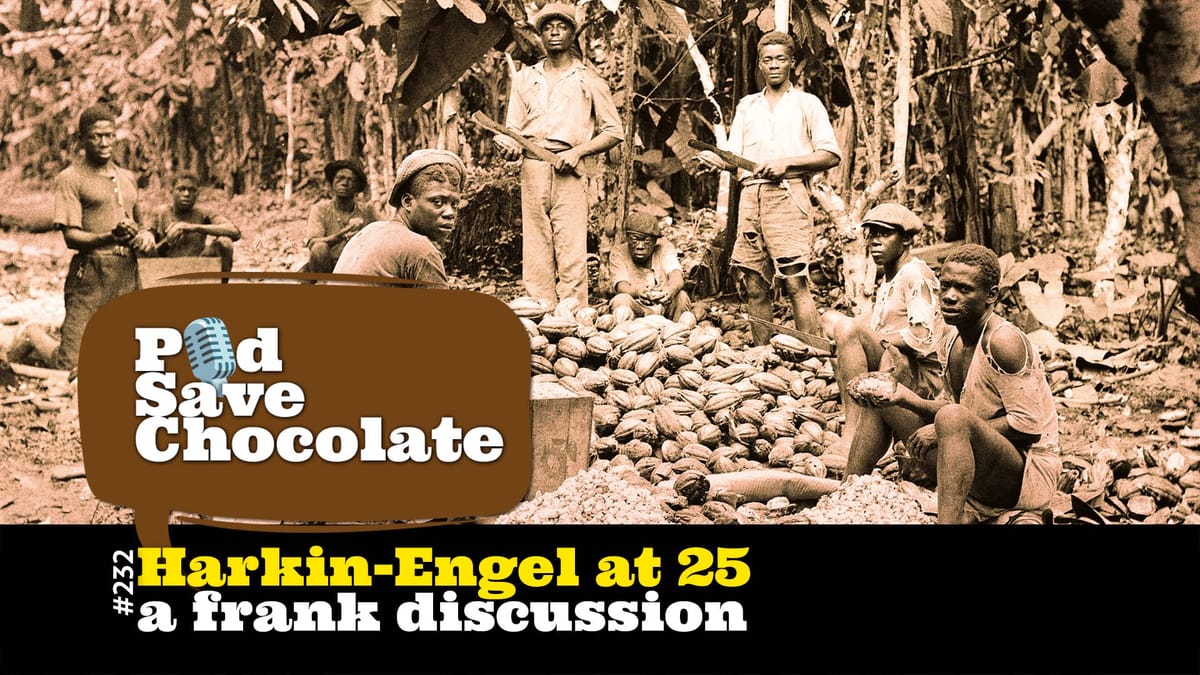
 Clay Gordon
 Clay Gordon
 Clay Gordon
 TheChocolateWire
 TheChocolateWire
 Clay Gordon
 Clay Gordon
Future Episodes
Hot Take: The new “Certified Ceremonial Cacao” certification.
Episode Hashtags
#MrBeast #Feastables
#cocoa #cacao #cacau
#chocolate #chocolat
#PodSaveChoc #PSC
#LaVidaCocoa #TheChocolateLife
#PodSaveChocolate and #TheChocolateLifeLIVE Archives
To read an archived post and find the links to watch archived episodes, click on one of the bookmark cards below.
 Clay Gordon
Episodes 201-300 (links to older PSC archives are in the top nav).
Clay Gordon